Museum Lighting: Managing Light Exposure Without Losing Visibility
An exhibition can satisfy a lighting specification at opening and still expose an object to more light than its conservation plan intended. A spotlight may be on during cleaning, daylight may reach a case before visitors arrive, or a later adjustment may change the light falling on a sensitive surface. A single illuminance reading does not describe any of those hours.
Museum lighting therefore requires two decisions at once: how visitors will see the object and how much exposure the institution is willing to accept over time. For contractors, facility teams and distributors supporting cultural projects, the practical task is to translate those decisions into a controllable installation and a record that the museum can maintain.
The essential distinction: illuminance, measured in lux, describes the light falling on a surface at a moment. Exposure, expressed in lux hours, combines illuminance with duration. Neither an LED label nor a familiar lux number guarantees that an object will remain unchanged.
This guide reflects source material available as of November 14, 2026. Its calculations are illustrative, not preservation limits. The responsible conservator and collection owner must determine the acceptable conditions for each object and exhibition.
Why light exposure is a conservation decision
The Canadian Conservation Institute (CCI) describes the tension between present visual access and the irreversible deterioration that light can cause. Visible light itself can fade sensitive colourants. Removing ultraviolet radiation is important, but it does not remove the risk from visible light; infrared can also contribute to heating.
The consequences are not identical across a collection. A display may combine a light-sensitive textile, a printed label, a painted object and a relatively insensitive support. Their materials, condition, significance, previous exposure and intended future use can differ. A limit suitable for one object cannot simply be copied to every surface in the room.
The often-cited 50 lux figure has a historical role in museum practice. It is not a threshold below which damage stops, and it is not a universal instruction for every object. A conservation decision may call for a different illuminance, a limited display period, rotation, a replica, or no display at all. Those choices belong to the institution, not the lighting supplier acting alone.
Visibility is more than a number
Dimmer is not automatically better if visitors cannot see the detail that justified exhibition. CCI notes that adaptation, dark surfaces, fine detail and viewer age affect visibility. A visitor entering a dim gallery from a bright lobby may need time to adapt; a dark object behind reflective glazing may need a different viewing arrangement from a light-coloured object.
Before increasing output, consider the whole visual setting: transitions into the gallery, reflections on glazing, background contrast, object orientation and the position from which visitors actually look. A trial with the conservator and exhibition team can reveal whether an apparent visibility problem is caused by reflections or adaptation rather than insufficient light on the object.
Accessibility and preservation should be discussed together. The team can test sightlines and legibility with representative users while the conservator assesses the exposure implications. No single adjustment removes the need to make that trade-off explicit.
Build an object-level exposure budget
For a constant measured illuminance, the basic planning equation is:
Exposure in lux hours = illuminance in lux × time in hours.
When conditions change, calculate each period separately and add the results. A practical ledger distinguishes public opening, cleaning, preparation and any other period when light reaches the object. Daylight and electric light can overlap; avoid counting the same hour twice, and use the combined illuminance at the object for that period.
For variable conditions, a series of representative readings or a suitable logger can improve the estimate. A scheduled operating time is not proof of actual exposure: a bypass, an event or a changed blind position may alter it. The object surface, not the luminaire setting or the floor, is the relevant measurement location.
Lux hours are a planning proxy. For the same object under the same spectrum, they help compare simple schedules, but equal totals do not establish equal damage across different materials or spectral distributions. Past exposure, material behaviour and the institution’s risk tolerance still matter. CCI discusses both cumulative exposure and material sensitivity in its light deterioration guidance .
A hypothetical schedule comparison
The following example compares the same hypothetical object under the same light spectrum. The figures are invented solely to show the arithmetic; they are not recommended limits, a real project or a claim that either option is safe. The two schedules describe the same one-week display period.
| Exposure period | Schedule A | Schedule B |
|---|---|---|
| Visitor viewing | 60 lux × 40 h = 2,400 lux hours | 80 lux × 20 h = 1,600 lux hours |
| Preparation and cleaning | 60 lux × 5 h = 300 lux hours | 80 lux × 5 h = 400 lux hours |
| Total for the week | 2,700 lux hours | 2,000 lux hours |
A ledger can also identify missing information before it becomes an operational assumption. Record the person supplying each estimate and the dates to which it applies, so the next team can distinguish an observation from a forecast. If a case receives daylight during setup, the assumed constant reading may not represent that period. The team must revise the calculation using appropriate combined readings rather than quietly omitting the additional contribution.
Schedule B has a higher viewing illuminance but a lower calculated total because the light is on for fewer hours. The difference is 700 lux hours, or approximately 25.9% of Schedule A’s total. If the same weekly conditions continued for a hypothetical 10 weeks, the totals would be 27,000 and 20,000 lux hours respectively. That multiplication assumes the same measured illuminance and duration each week, with no additional exposure.
The table does not establish that Schedule B provides equal visitor access: its viewing hours are shorter. Nor does it predict the object’s visible change. The museum must decide whether the proposed access, brightness and cumulative exposure are acceptable together. If the object has already been displayed elsewhere, the conservator should consider that history rather than treating the new ledger as a fresh lifetime allowance.
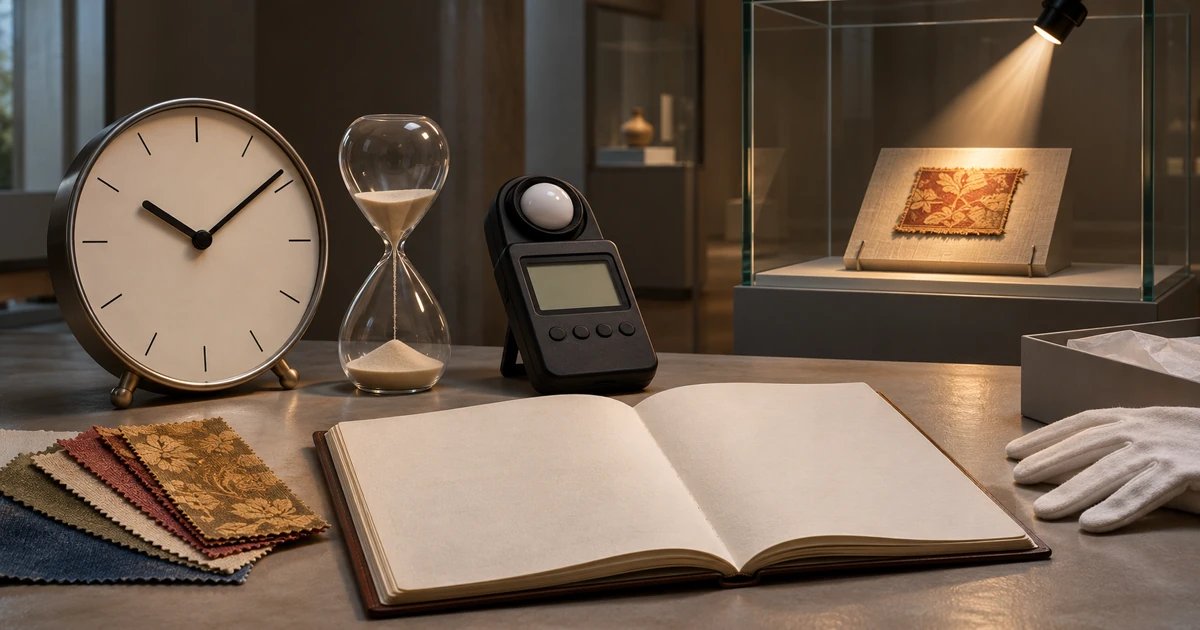
Conceptual illustration: a schedule ledger connects measured object illuminance with the hours of exposure discussed above; it is not a measured installation.
Turn the budget into an exhibition specification
A useful specification states not only a target but also who establishes it, where it is measured and what happens when conditions change. The following allocation is a project workflow, not a substitute for an institution’s own governance.
| Decision or record | Responsible party to identify | What the project needs |
|---|---|---|
| Object sensitivity and acceptable exposure | Collection owner and conservator | Object-specific decision, assumptions, prior exposure where known and display duration |
| Visitor experience | Curator, access team and conservator | Viewing needs, adaptation, reflections and approved trade-offs |
| Lighting design and controls | Designer and contractor | Object measurement points, adjustable output, zoning and operating sequence |
| Evidence and handover | Supplier and contractor | Relevant source data, installed settings, measurement records and control instructions |
| Operation and change control | Museum facilities and collections staff | Named owner for schedules, monitoring, overrides and reapproval |
Assign names and approval dates, not just departments. The contractor can propose a control sequence, but should not silently decide that an object may receive a higher exposure. Similarly, a conservation target cannot be implemented reliably if the operational team does not know which circuit, scene or blind position keeps it in effect.
The written scope should include all contributors to object illumination: display fittings, ambient lighting, daylight, temporary work lighting and any overlapping periods. Identify whether cleaning scenes illuminate objects, whether emergency or security lighting affects the ledger during normal operation, and who may override the schedule. Safety and emergency requirements remain subject to the applicable authorities and the institution’s procedures; conservation controls should not be used to defeat them.
Define measurement before procurement
Specify the object surface and orientation at which measurements will be taken. A horizontal reading on the floor is not interchangeable with a reading at a tilted painting or the vertical face of a textile. Record a reference point and meter orientation so later readings can be compared meaningfully; use multiple points if illumination varies across the object.
State the intended scene, surrounding light conditions and daylight or blind position. Ask for a suitable calibrated illuminance meter and record its identification and calibration status. Measurement uncertainty, access constraints and changes in ambient light should be noted rather than hidden behind a single precise-looking number.
A design calculation is useful for planning, but it does not replace on-site readings after aiming, case glazing and room finishes are in place. The conservator should decide how measured results are assessed against the approved object-specific plan.
Evaluate the source and controls together
LED is a technology category, not a conservation outcome. CCI’s Technical Bulletin 36 describes differences among LED sources, including differences in light quality and potential fading. Its market observations reflect the historical period studied, not a survey of the current market.
Request evidence for the actual proposed source and operating configuration: spectral information where available, colour characteristics, dimming range and compatibility with the intended control system. Ask what changes when the source is dimmed and whether the documented data apply at the setting used for display. If information is missing, record that gap for the designer and conservator rather than assuming equivalent behaviour from a similar product.
CCI’s bulletin defines good-quality light using a colour rendering index (CRI) of at least 90, R9 of at least 50 and a Duv at purchase between −0.003 and +0.003; excellent-quality light raises R9 to at least 90 while retaining the other criteria. Duv describes a source’s chromaticity offset from the blackbody locus, while R9 concerns saturated-red rendering. The bulletin’s simplified recommendations for most users omit Duv. These are CCI’s source-quality guidance, not universal legal requirements or guarantees against fading. Colour quality supports viewing decisions but does not replace assessment of spectrum, exposure duration and object sensitivity.
The procurement record should distinguish a source’s published data from the performance of the finished installation. Optics, glazing and ambient light affect what reaches an object. Supplier documentation supports the design review, while the commissioning measurements establish the installed baseline. Any proposed substitution needs the same review rather than automatic acceptance under the original specification. The handover should retain the final approved documentation alongside the installed settings and any documented deviations, together with the relevant acceptance measurements.
Dimming and scheduling are useful only when their installed behaviour is verified. The team should test the lowest usable setting, repeatability after a power interruption, scene recall, local overrides and any response to a control-system fault. A sensor that reduces hours should be checked in the actual visitor arrangement, including whether its detection area and delay create unwanted dark periods or leave lights on unnecessarily.
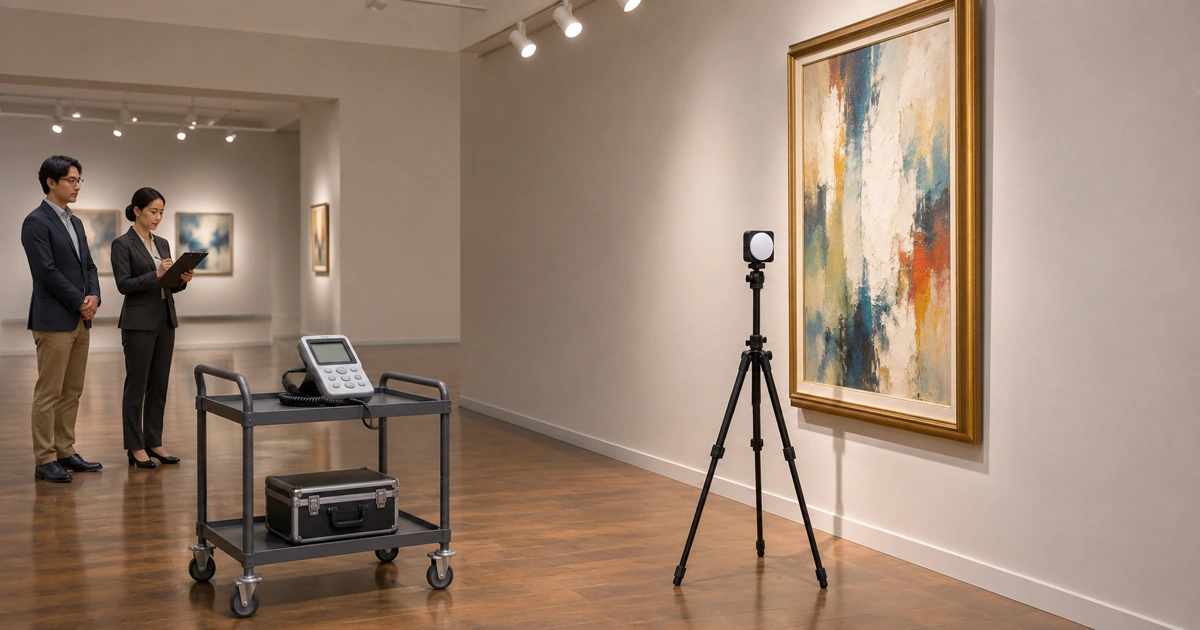
Conceptual illustration: acceptance checks relate the object-surface measurement, installed scene and control record described above; no measured installation is depicted.
Commissioning and handover: what to record
Museum lighting acceptance should establish a repeatable baseline, not merely confirm that the lights turn on. The CIE 157:2004 official abstract describes a practical procedure covering setup of a new display and monitoring over its life. The abstract does not supply the numerical limits for a particular object; the full report was not consulted for this article.
A useful handover record contains:
- Object and approval: object identifier, location, approved display period, conservation decision and approver. Document unknown exposure history as unknown.
- Measurement conditions: date and time, meter identification and calibration status, point and orientation, readings, scene, daylight conditions and relevant glazing or blind position.
- Installed equipment: source and luminaire identification, positions, aiming, filters where specified, control zones and any departures from the approved design.
- Operating schedule: visitor, preparation and cleaning periods; sensor settings; override permissions; and the assumptions behind the lux-hour calculation.
- Exceptions and ownership: unresolved readings or data gaps, corrective actions, responsible people, remeasurement triggers and the person holding the current record.
Test representative operating modes with the people who will use them. For example, verify that a cleaning override returns to the approved scene and document what happens if a display is left on after an event. If a scene is changed during commissioning to improve visibility, repeat the relevant readings and obtain the required conservation approval before treating the new setting as the baseline.
A photograph of the arrangement can help staff restore aiming, but it is not a substitute for a measurement. Keep the record accessible to facilities and collections staff, with a clear version date. A new lamp, moved case, altered opening schedule or changed window treatment can make the original calculation obsolete.
Monitoring, exceptions and object rotation
A ledger is useful only if someone maintains it. Compare the actual schedule with the assumed one and record exceptional events. If a conservator-approved exposure allowance is used, track the accumulated estimate against that particular allowance; neither the allowance nor the interval for review should be assumed to apply to another object.
When a reading or operating schedule differs from the approved plan, record the period and conditions, notify the designated collections contact and agree on corrective action. Depending on the institution’s decision, that may mean adjusting a scene, reducing future hours, investigating daylight, or temporarily removing the object. Do not conceal an overrun by resetting the counter at the next exhibition.
Rotation can distribute display time among objects or give visitors access through a replica, but it does not reverse deterioration already incurred. A new object in the same case requires its own sensitivity assessment, approval and measurement. Likewise, a new source spectrum makes the original same-spectrum schedule comparison an insufficient basis for claiming equal damage.
Common questions about museum lighting
Is a low lux reading enough to demonstrate preservation?
No. A reading captures a moment, not the entire exposure history. The institution also needs duration, material sensitivity, spectral considerations and an approved approach to monitoring. A low value may still cause change over time.
Can occupancy controls replace a conservation plan?
No. They can reduce unnecessary operating hours when designed and verified appropriately. They cannot decide an acceptable exposure for an object, document past display or guarantee usable visibility for every visitor.
Who approves a change after handover?
The institution should name that authority in the project record. A facilities team may be authorised to restore an approved scene, while a change to illuminance, duration, source or object normally needs review under the collection owner’s conservation procedures. The exact approval route is institution-specific.
Conclusion
A defensible exhibition lighting plan connects a conservation decision to a visible, measurable and maintainable installation. Object-specific approvals set the boundaries; a lux-hour ledger makes operating assumptions visible; and commissioning records allow the museum to detect changes over the life of the display. The outcome is not a promise of zero damage, but an explicit balance between access today and preservation for the future.
Sources
- Canadian Conservation Institute, Agent of Deterioration: Light, Ultraviolet and Infrared : exposure, material sensitivity, damage and visibility.
- Canadian Conservation Institute, LED Lighting in Museums and Art Galleries, Technical Bulletin 36 (2020) : source characteristics and historical LED guidance.
- International Commission on Illumination, CIE 157:2004, Control of Damage to Museum Objects by Optical Radiation : official abstract only, for the report’s scope and monitoring procedure.
Next source review: May 14, 2027.