EU PPWR for Lighting Importers: Packaging Rules, Dates and Duties
A glass pendant shipped from an Asian factory reaches a European warehouse inside several layers of packaging: a printed colour box, foam or pulp inserts, a plastic bag for the canopy and screws, a master carton, and a stretch-wrapped pallet. Until this summer most importers treated that stack as a logistics cost. Since 12 August 2026 it has its own conformity regime, separate from the luminaire’s CE marking.
Regulation (EU) 2025/40 (PPWR) brings a declaration of conformity for packaging, a clear rule on who is the “manufacturer”, and design rules that bite from 2028 and 2030. This article explains what that means for brand owners, distributors and importers of luminaires, and what to request from suppliers.
Information in this article is current as of 14 October 2026. Article numbers refer to Regulation (EU) 2025/40 as published; several dates depend on delegated and implementing acts that are not yet adopted. This is not legal advice.
1. What Changed on 12 August 2026
The PPWR was adopted on 19 December 2024, entered into force on 11 February 2025 and has applied since 12 August 2026 (Art. 71), repealing Directive 94/62/EC from the same date.
- It is a regulation, not a directive. It applies directly in every member state; national EPR schemes and fees remain.
- Packaging has its own conformity regime. Packaging must meet Articles 5 to 12, backed by technical documentation and an EU declaration of conformity (DoC).
- Details are still to come. Around 30 delegated and implementing acts will define labels, recyclability criteria, empty-space methodology and registration formats; several dates run from those acts.
The Commission’s guidance document C(2026) 3702 (5 June 2026) and its Questions and Answers (March 2026, updated August 2026) set out the transition:
- Packaging placed on the market before 12 August 2026 may stay on the market.
- Stock produced earlier but not yet placed on the market need not be destroyed or relabelled (PFAS is the exception).
- Goods in transit through the EU to non-EU destinations are not “placed on the market”.
- Authorities should first require corrective action before withdrawal or recall.
2. Who Is the Manufacturer, Importer and Producer?
Manufacturer: the name on the box
Under Art. 3(13), the manufacturer is the person that manufactures packaging or a packaged product. But where a person has packaging or a packaged product designed or manufactured under its own name or trademark, that person is the manufacturer, regardless of other trademarks visible. A narrow exception applies only where the brand owner is a micro-enterprise and its packaging supplier is in the same member state; the supplier is then the manufacturer. It does not help brands packing in Asia. The Commission FAQs add that the owner of a name or trademark on packaging can be assumed to be the manufacturer.
For private-label lighting the consequence is direct: when an Asian factory packs a wall light into a colour box printed with the buyer’s brand, the brand owner is the manufacturer and signs the DoC; the factory is a supplier.
Importer and supplier
Under Art. 3(17), the importer is a person established in the EU that places packaging from a third country on the market. Art. 18 requires the importer, before placing packaging on the market, to ensure the manufacturer carried out the conformity assessment (Art. 38) and drew up the Annex VII technical documentation, and that packaging is labelled under Art. 12 and accompanied by the required documents. The Commission FAQ states the importer is responsible for ensuring the manufacturer has complied.
Art. 16 obliges suppliers of packaging or packaging materials to give the manufacturer all information and documentation needed to demonstrate conformity, in a language the manufacturer understands. This is the legal basis for requesting material data and test reports.
| Role in a lighting supply chain | PPWR role | Core duty |
|---|---|---|
| Brand owner whose name is on the box | Manufacturer (Art. 3(13), 15) | Conformity assessment, technical documentation, DoC |
| EU company importing from Asia | Importer (Art. 3(17), 18) | Verify manufacturer compliance first |
| Asian factory or carton printer | Supplier (Art. 16) | Provide data and documents |
| First to make packaging available in a member state | Producer (Art. 3(15), 44, 45) | EPR registration and fees |
One company often holds several roles: a brand owner that imports its own goods is typically manufacturer, importer and producer at once.
3. What Applies Now
Declaration of conformity and technical documentation
Under Art. 15, manufacturers may only place packaging complying with Articles 5 to 12 on the market. They carry out the conformity assessment (Annex VII, Module A, internal production control), draw up technical documentation and issue a DoC under Art. 39 following Annex VIII. The DoC is kept updated and translated as each member state requires. Documentation is kept 5 years for single-use and 10 years for reusable packaging.
Identification and contact details
- Art. 15(5): a type, batch or serial number or other identification element on the packaging, or in an accompanying document where size does not allow.
- Art. 15(6): the manufacturer’s name, registered trade name or trademark and postal address, plus electronic contact where available, on the packaging or via a QR code or data carrier.
For private label, that means the brand owner’s details, not the factory’s.
Heavy metals and substances of concern
Art. 5(1) requires substances of concern to be minimised. Art. 5(4) keeps the old limit: lead, cadmium, mercury and hexavalent chromium together must not exceed 100 mg/kg in packaging or packaging components. The change is that compliance must now be demonstrated in the technical documentation (Art. 5(6)). In lighting packaging, check printing inks, pigments, coatings, adhesives, tapes and coloured plastic bags.
The PFAS limits in Art. 5(5) apply only to food-contact packaging, so they rarely touch luminaires. A Commission report with ECHA on substances of concern in packaging is due by 31 December 2026 (Art. 5(2)).
Art. 6(1) already states that all packaging placed on the market shall be recyclable; grading follows later.
4. Lighting Packaging Materials and the 2030 Recyclability Rules
Recyclability grades
Design-for-recycling criteria apply from 1 January 2030, or 24 months after the delegated acts (due by 1 January 2028), whichever is later. Packaging must then reach a grade under Annex II, Table 3. Criteria are set per packaging category based on the predominant material, and the assessment is expressed per packaging unit, in terms of weighting:
| Grade | Recyclability score | Status |
|---|---|---|
| A | ≥ 95% | Allowed |
| B | ≥ 80% | Allowed |
| C | ≥ 70% | Allowed until 1 January 2038 |
| Below C | < 70% | Not allowed |
A “recycled at scale” assessment is added from 1 January 2035, or five years after its implementing act, whichever is later.
Recycled content in plastic parts
Under Art. 7, plastic parts of packaging other than contact-sensitive packaging and beverage bottles need 35% post-consumer recycled content from 1 January 2030 (or three years after the implementing act, whichever is later) and 65% from 1 January 2040, with some exemptions such as compostable plastic packaging. This general category covers the EPS blocks, PE foam, bubble wrap, accessory bags and plastic windows typical in lighting; contact-sensitive plastic packaging and beverage bottles have separate rates (Art. 7(1)(a)-(c)).
Where lighting packaging is exposed
The likely problems after 2030 are mixed-material builds: foam glued to board, laminated or metallised gift boxes, plastic windows, heavy coatings and composite inserts. Mono-material designs, such as corrugated boxes with corrugated or moulded fibre inserts, are easier to grade. Final outcomes depend on the delegated acts.
| Component | Typical material | Articles | Request from supplier |
|---|---|---|---|
| Colour box (sales packaging) | Coated board or corrugated | 5(4), 6, 15 | Material spec, ink and coating heavy-metal evidence, artwork with markings |
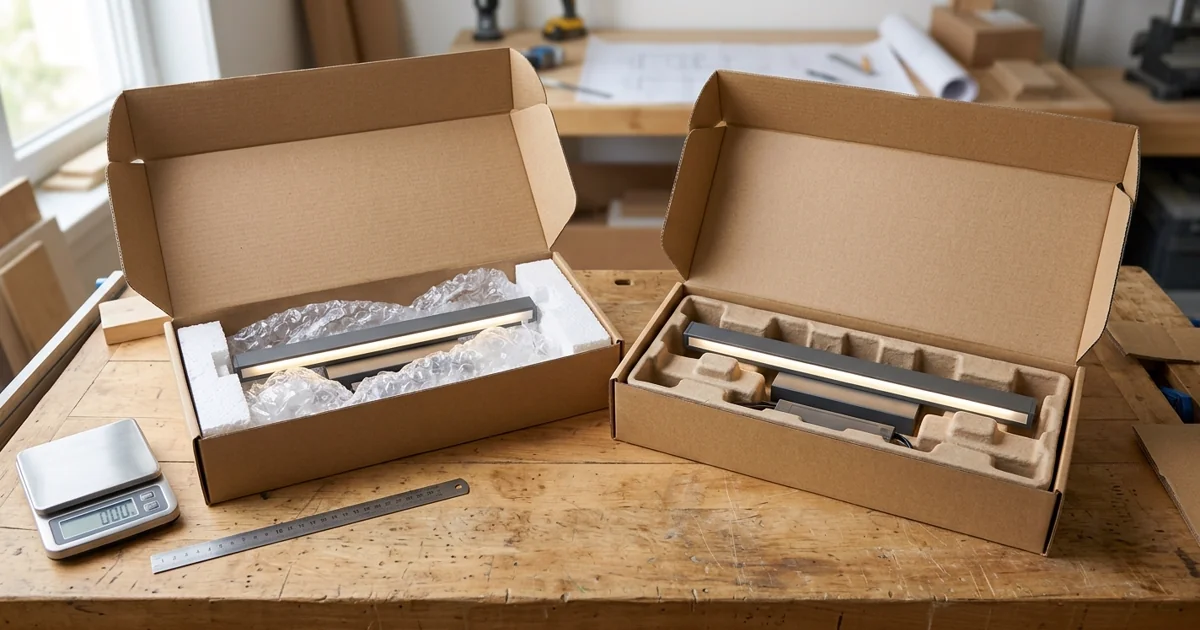
| Protective inserts | EPS, PE foam, moulded pulp, corrugated | 6, 7, 10 | Material and weight per unit, recycled content |
| Shade and diffuser wrap | Bubble wrap, foam sheet, paper | 6, 7, 10 | Material, weight, reason for each layer |
| Accessory bags | PE film | 5(4), 7 | Polymer, colourants, recycled content |
| Master carton | Corrugated | 6, 10, 24 | Dimensions, board grade, weight, fill plan |
| Pallet wrap, tapes, labels | PE, PP, adhesives | 5(4), 6, 7 | Composition and declarations |
5. EPR Registration and Authorised Representatives
Under Articles 44 and 45, producers must register in each member state where they make packaging available for the first time, and Art. 44(4) bars making packaging available there without registration.
National registers under Art. 44 must be set up within 18 months of the implementing act on the registration format. That act was due on 12 February 2026 and had not been adopted by mid-2026; a draft went to consultation during the year. Until then, existing national EPR registers and systems keep operating, so current registrations should be kept up to date.
Art. 45(3) requires producers selling directly to end users in another member state to appoint an authorised representative for EPR there; member states may also require producers established outside the EU to appoint one. The Commission’s Environmental Omnibus of 10 December 2025, COM(2025) 982, proposes suspending the obligation for EU-established producers until 1 January 2035. As of October 2026 it is not adopted, and it would not cover producers outside the EU.
PPWR duties run in parallel with product rules such as digital product passports under ESPR .
6. Minimisation and the 50% Empty Space Ratio
Minimisation (Art. 10)
By 1 January 2030, the manufacturer or importer must ensure packaging weight and volume are reduced to the minimum necessary for functionality. Features aimed only at increasing perceived volume, such as double walls, false bottoms and unnecessary layers, are prohibited, with limited design-right exceptions.
Compliance is shown against the Annex IV criteria: product protection (mechanical damage, vibration, compression), manufacturing process, logistics, functionality, information requirements, hygiene and safety, legal requirements, and recycled content, recyclability and reuse. The file must identify the design requirements that prevent further reduction, and any test results or simulations used.
This is where a glass shade or long linear fixture justifies its protective volume, but only if documented. Drop and transit test results, for example to ISTA procedures, are exactly the evidence Annex IV anticipates. CEN is to be mandated (request due by 12 February 2027) to develop harmonised minimisation standards.
Empty space ratio (Art. 24)
By 1 January 2030, or three years after the methodology implementing act (due by 12 February 2028), whichever is later, operators that fill grouped, transport or e-commerce packaging must keep the empty space ratio at or below 50%.
Under Art. 3, sales packaging is the sales unit to the end user; grouped packaging groups sales units; transport packaging serves handling and transport, excluding road, rail, ship and air containers; e-commerce packaging is transport packaging delivering distance sales to the end user.
Empty space is the total volume of the outer packaging minus the volume of the sales packaging inside; the ratio is empty space divided by total volume. Void fill, including paper, air cushions, bubble wrap, foam and polystyrene chips, counts as empty space.
Hypothetical worked example (round numbers). A 100-litre master carton holds six 10-litre colour boxes: 40 litres empty, a 40% ratio. Put the same six boxes in a 150-litre carton topped up with paper and empty space becomes 90 litres, a 60% ratio, which would fail. Exact measurement rules await the methodology act.
The methodology must allow for fragile products, irregular shapes and label space. Sales packaging used directly as e-commerce packaging, and reusable packaging in a reuse system, are exempt from the ratio but still subject to Art. 10. Under Art. 24(4), empty space in sales packaging must be reduced to the minimum by 12 February 2028; a 2032 review may add ratios for electronic products. The practical response is right-sized master cartons.

7. Common Misconceptions
“The factory packs it, so the factory is responsible.” If the box carries your brand, you are the manufacturer under Art. 3(13).
“Nothing changes until 2030.” The DoC, markings and heavy-metal limit apply now.
“Paper void fill is fine because it is recyclable.” Recyclability and empty space are separate tests; paper fill counts as empty space.
“Fragile products are exempt.” Fragility is a design requirement you document under Annex IV, not an exemption.
8. Supplier and Packaging Checklist for Lighting Buyers
- Roles per SKU: manufacturer (brand on box), importer, and EPR producer in each member state.
- Bill of packaging materials: every component, material and weight per unit.
- Heavy-metal evidence (Art. 5(4)) for inks, coatings, adhesives, tapes and coloured plastics.
- Drawings of colour boxes and master cartons, with units per carton.
- Markings: identifier (Art. 15(5)) and brand owner’s name, address and electronic contact or QR code (Art. 15(6)).
- Transit test results for glass shades, diffusers and long linear bodies, filed as Annex IV evidence.
- DoC to Annex VIII, updated on change, retained 5 or 10 years.
- Change notification clause: no change of board, inserts, inks or coatings without notice.
- 2030 review: mixed-material builds, EPS and PE parts, master cartons over 50% empty space.
| Date | What happens | Article |
|---|---|---|
| 12 Aug 2026 | PPWR applies: DoC, documentation, identification, heavy metals | 5, 15, 71 |
| 31 Dec 2026 | Report on substances of concern | 5(2) |
| 12 Feb 2028 | Sales packaging empty space reduced to minimum | 24(4) |
| 12 Feb 2028 | Empty space methodology act due (50% ratio follows from 2030 or later) | 24(2) |
| 12 Aug 2028 | Harmonised material label (or later if secondary acts are delayed) | 12 |
| 1 Jan 2030 | Grades A-C, 35% recycled plastic, minimisation, 50% ratio (or later if secondary acts are delayed) | 6, 7, 10, 24 |
| 1 Jan 2035 | “Recycled at scale” assessment (or later) | 6 |
| 1 Jan 2038 | Only grades A and B | 6 |
| 1 Jan 2040 | 65% recycled plastic content | 7 |
The labelling implementing acts, first expected in August 2026, are now expected in Q4 2026 according to EUROPEN.
9. FAQ: PPWR Questions From Lighting Importers
Must we relabel stock that arrived before 12 August 2026? No. Packaging already placed on the market may stay there, and earlier stock not yet placed need not be destroyed or relabelled, PFAS aside.
Does the 50% rule apply to colour boxes? No. It covers grouped, transport and e-commerce packaging. Sales packaging must reach minimum empty space by 12 February 2028 under Art. 24(4).
What should our factory send us? Under Art. 16: material compositions and weights, heavy-metal evidence, drawings and transit test results, in a language you understand.
Conclusion
The PPWR turns packaging into a documented, regulated item. For lighting sold under a brand owner’s name, the brand owner is the manufacturer and holds the DoC and technical documentation, while the importer verifies it. The declaration, markings and heavy-metal limit already apply; recyclability grades, recycled content, minimisation and the 50% empty space ratio are set for 2030, subject to the secondary acts.
The work starts with data: packaging materials per SKU, supplier declarations and transit evidence for fragile products.
Sources
- Regulation (EU) 2025/40 of 19 December 2024 on packaging and packaging waste (OJ L, 2025/40; ELI https://data.europa.eu/eli/reg/2025/40/oj ), Articles 3, 5, 6, 7, 10, 12, 15, 16, 18, 24, 39, 44, 45 and Annexes II, IV, VII, VIII
- European Commission, Guidance document on the Packaging and Packaging Waste Regulation, C(2026) 3702, 5 June 2026
- European Commission, PPWR Questions and Answers, March 2026 (updated August 2026)
- European Commission, Proposal COM(2025) 982 of 10 December 2025 suspending the rules on the appointment of an authorised representative for EPR (batteries and packaging)
- EUROPEN, “12 August 2026: Ready or not, here comes the PPWR!” (status of implementing acts)
Next scheduled review: April 2027, or earlier when the labelling, register or empty-space implementing acts are adopted.